
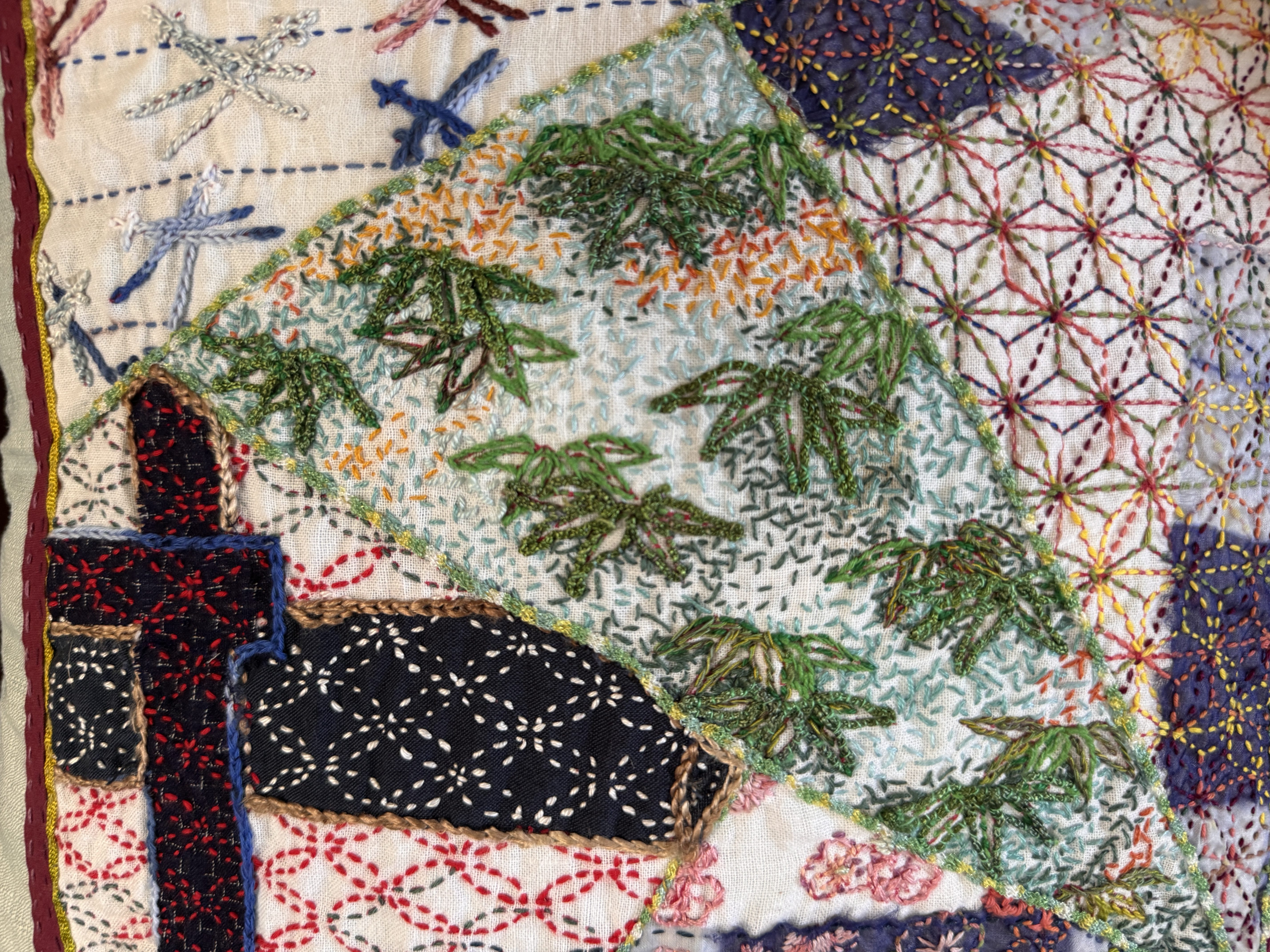

Deb is joining us at ‘from out of the blue studio gallery’ for an intense week long residency. Here is more information about her life and her practice so we can all get to know her a little bit.
What initially attracted you to the methods you use for your art practice?
While using dye resist methods as a young textile student in the seventies, then later as a teacher, I realised that cultural practices around the globe have their own dye resist traditions. That an evolution of cultural origins allows contemporary works to come from methods like; stitch, shibori, felt and katazome (paper stencil), which have led me to layering these techniques to give a sense of time, crossing national borders and telling new stories.
What or who were your early influences and how has your life/upbringing influenced your work?
There were several very good artists and design teachers that I was fortunate to meet at my primary school St Anne’s convent in Wellington. These teachers inspired me by sharing their skills while both my parents encouraged me to explore art and image making from an early age. As a left handed embroidery student I ended up teaching other left handers. Our family dining table hosted many a late night drawing for my year 11 portfolio and strong art mentors, one was Sylvia Gurr a teacher and survivor of a WW2 concentration camp and a Dadaist. Sylvia was very encouraging of girls seeking a career in art and she impressed on us to be our best selves. I studied Art History at high school and more recently taught surrealist art and photography, I now understand her formative Dadaist influences.
What was your route to becoming an artist?
It was a gradual route, after undertaking 3 years training at Wellington Design School training under printmakers Kate Coolahan and John Drawbridge and commercial weaver Max Mund, they provided me with a foundation in design industry arts. Then followed a Sydney internship in my final year as a textile and fashion design assistant followed by jobs in textile design and a marriage that fed my commercial career interests and dreams of a design inhabited career. After my mother’s death in 1991, which I felt deeply, I worked as an art and textile teacher and a collegial art history teacher encouraged me to take opportunities to travel and study in Japan with culturally based printmakers and textile arts. I started teaching art and photography, set up a new print business South Pacific Design in NZ inspired yukata robes, and married a second time into a family who have supported my interests in travel and art. This has allowed me to focus on being a feminist migrant arts advocate based in Aotearoa.
Several research trips and residencies in Asia helped me to understand more about the eastern mind and my mother’s cultural beliefs. I have been fortunate to have had this support so far, and feel there is much more to be explored in combining writing and practice in arts residencies and accepting challenges faced by community arts groups
Tell us a bit about your process from conception to creation please.
I think it’s important to locate yourself, either through memories, people or physical and natural environments. That has led to an interest in natural dyes and what is native and what is introduced to my current site. A 2017 group art residency in Dali, Yunnan region, China was a great resource to see introduced botanical culture plants and a high number of diverse ethnicities. In fact, relocating seeds from afar was a resource in my parent’s home garden that I have adopted. In my case, indigo, (persicaria tinctorium) which carries personal memories for me and gives me a cellular building block for the creative process. I mix in synthetic dyes to the composition also as aide de memoire to identity and hybridity as layers with an aim to create my own story. Observational drawing has given way over the years to photography while travelling, but my visual diaries contain drawings, water colours and notes of traces of stories told to me firsthand, like my father’s research time at Scott Base, Antarctica in the 1960s and then reimagined and added to a broader local community aspects like Aotearoa Felter’s group 2009. I’m currently reading about the Japanese natural mud dyeing (dorozome) practices of Amami Oshima and continue to weave stories into my textile works as memories of ‘being there’. I sometimes create short films, to capture some of the connections made, and include visual clues and details that I often miss at the time.
While I enjoy the conceptual process, it’s the planned exhibition and sharing of traces with others that often bears witness to each location, like a point on a map.
What currently inspires you?
I am currently seeking technical areas to consolidate and add to my ideas, and deconstructing previous works to revisit. A creative reflection process can help the subconscious lift missed opportunities into sight.
Is there a piece of your work that holds particularly fond memories for you and why?
I continue to find out more about my migrant family histories and artefacts which are an unending source of inspiration. Reducing some of these memories into symbols and a visual language interests me. My Windows on White Aotearoa felt touring exhibition pieces titled Time Flies and Translations(2008), using shibori techniques on silk and merino wool nuno felt works possibly conveys some of my best reduced memories. It remains white to this day.
How has your work developed since you began and how do you see it evolving in the future?
Colour has been a strong feature in my past works, texture and composition developed into different pathways and techniques. Japan blue, indigo and Japanese madder are currently taking a lot of my time in experiments and stitching which has slowed down my pace as I go deeper. I often find bouncing ideas around using different techniques including intergenerational digital and hand-made skills offers me several perspectives to regroup. I think being curious and experimental and open to making mistakes by re-reading later is a strength that many artists have. I’m happy to let new ideas and resources fall out of the initial design stages often in the company of senior or junior artists for their initial feedback. I revisit motifs or concepts as long as my intuition tells me the process leads to my next evolutionary point.
What advice would you give young people considering following their dream of being a full time artist?
To build your own art career into a visual language you need: support, resourcefulness, self-motivation, imagination and some energy to make it happen. Find your tribe and get going. Enter lots of creative community competitions or find an environment that suits and values your type of art.
What is something you cannot take your eyes off when you see it – that fascinates and mesmerises you?
Currently, any work that contain clues leading and feeding the mind and heart on two journeys at the same time.
What is your favourite way to unwind or de-stress?
If my senses are overwhelmed or my nerves out of balance I am reminded to take myself to Raumati beach and watch a sunset. Green bathing works as a reset or cleansing process for me too, bamboo groves at dawn or a walk through a forest of trees works any time.


Artist CV
Deb Donnelly
debdonnellydtd@gmail.com
https://www.behance.net/debdonnelly
Instagram debdonnelly1
Donnelly is an Interdisciplinary artist based in Aotearoa New Zealand. Donnelly trained at Wellington Polytechnic in printmaking and textiles before taking up post-graduate studies in tertiary and secondary art education and curatorial roles in materials cultures that allow migrant cultures a voice in the Aotearoa and Pasifika social arts fields.
Resume
Deb Donnelly lives on the Kapiti Coast, New Zealand. Her art works have been exhibited nationally and internationally as a materials-based artist and on arts residencies abroad, mainly in Asia, Hong Kong, Shanghai and Dali, Yunnan province, China, Itoshima, Fukuoka and Okayama, Japan. NZ representative World Shibori Resist Art Textiles.
Currently, working as an interdisciplinary installation artist Donnelly uses her Aotearoa based Eurasian auto-ethnography; as a self-narrative that critiques the situatedness of self with others in social and environmental contexts. New work is based on her cross-cultural observations as an artist, connecting art processes and inviting audience interaction to pause and construct their own responses.
The research method of personal narrative and reflective practice has established a role as an arts practitioner. Currently collaborative art practice revolves around the notion of change in self, place, whakapapa symbols and materials. Deb’s interests involve working with diverse migrant or transient art communities. This art practice allows for film documentation of cultural diversity in Aotearoa.
Installation Works
A Place at the Kauri Table 2019
Deb Donnelly artist, curator, producer
Description of the installation work titled A Place at the Kauri Table 2019 and its presentation
A short film about six migrant women: afloat on a white cloth that captures their sites of identity. Table settings, as an arts installation device, are connected through materials that speak of ‘individual arrivals’ at the Kauri Table as metaphor for home. Each narrative invites the audience to experience new and past migrant reflections. The sequentially lit placements focus on memories of intergenerational migration. The settings speak to abuse or the experience of isolation and sometimes, the journey into a sense of well-being. Each woman is moved towards situating herself into kinship (what Māori think of as whanaungatanga) in Aotearoa/New Zealand.
Title: A Place at the Kauri Table
Participatory arts installation (film recording) of New Zealand migrant women’s inter-disciplinary arts, narrative film – 6 minutes. 2019
Work experience
2020 -2025 Secondary school teacher specialising in: Visual Arts, photography, art, graphic design and textile technology. Paraparaumu College 2023, Upper Hutt College 2023, Porirua College 2022, Kapiti College 2021,
2019 – 2025 Independent artist, curator and educator
2000 – 2019 Visual artist and design tutor, textile arts co-ordinator, arts manager Whitiriea Community Polytechnic and Te Auaha, Te Pukenga.
2005 – 2019 Co-programme manager/ Visual Arts lecturer
Education
2008 Masters in Teaching, Victoria University, Wellington.Studio work and exhibition practice
2002 Design Research Massey University
2000 Certificate in Adult Teaching Whitireia Polytechnic NZ
1989 Diploma in Teaching, Wellington College of Education
1980 Diploma in Textile Design – School of Design Wellington
Awards highlights list
2023 NZ/Japan exchange programme (NZJEP0 grant and arts residency at Arts Craft Village, Okayama and Amami Oshima tsumugi textile dyeing visits to studios.
2019 Japan Foundation and Ishibashi Foundation, cultural arts research grant for contemporary art – Japanese textiles https://www.jpf.go.jp/e/project/culture/exhibit/exchange/fellow_ishibashi/2019.html
2018 New Zealand Japan Education Programmes (NZJEP), and Whitireia Polytechnic NZ – Weltec research committee Grants awarded for Japanese cultural textiles study and artist in residence at Studio Kura, Fukuoka, Japan. https://www.ilep.ac.nz/nzjep
Exhibitions short list
2025 Feb- May co-curator Amami Oshima Nature! with Yukihito Kanai from Amami Oshima, Japan at Toi Mahara Gallery, Mahara place, Waikanae. Sponsored by Creative Communities Kapiti Coast District Council.
23 August – Arts co-ordinator Japanese Ikebana and Textiles works at Cultural Diversity Festival at Te Raukura Performing Arts centre Kapiti College.
2024 6-13 October -Aotearoa Shibui group show, artist and curator at Thistle Hall gallery, Cuba St, Wellington. Sponsored by Paraparaumu Community Board.
2024 February Kapiti Indigo exhibition at Tutere Gallery, Waikanae. Indigo vat dyeing, shibori arts and sashiko stitch summer workshops.
2024 23 November – 20 December Selected juried art work for Surface Design Association exhibition at from out of the blue studio gallery, Opunake, Taranaki.
2023 September Hanami at Roderick and Gillian Deane gallery Paraparaumu Library textiles exhibition and public sashiko workshops. Sponsored by Kapiti Creative Communities grant.
November – Hutt Japan Festival- Textiles and sashiko exhibition and display at Dowse Gallery, Lower Hutt.
2022 18 June – Japan Festival Wellington sashiko workshops and exhibition of cultural Japanese textiles sponsored by Japan Foundation.
Sept-November Arts co-ordinator tutor for Pasifika festival student photo exhibition, Porirua College.
2021 Kapiti College Students KYS Kapiti Arts trail exhibition. Exhibition artist and curator for A Place at the Kauri Table film and installation winning entry into YICCA international art contest, Milan, Italy.
Deb Donnelly originally trained as a Textile Designer in 1980 at Wellington Polytechnic. Her career continued in cultural ethnographic art forms in a range of media. After 10 years as a designer then visual artist Donnelly retrained as a secondary and adult educator with a Masters in Teaching 2008 from Victoria University. Following 20 years as a tutor and visual artist at Whitireia Community Polytechnic, Donnelly has returned to her first love of textiles that honour past lives and reveal connections through sustainable materials and interdisciplinary arts.
2020 A Place at the Kauri Table selected for Pah Homestead Auckland Wallace finalists at Salon de refuses. Wairoa Maori film festival entry in Crosswinds category.
2019 Moving Continents: Japan Blue Aizome set of collaboration exhibitions with Hiroshi Tomihisa, Te Auaha Gallery, Wellington & Suter Gallery, Nelson and AP@KT2019 short film and oral presentation for NZ Costume and Textile Association Symposium Suter Gallery.
2019 A Place at the Kauri Table, installation at ITP Whanaungatanga research symposium EIT, film and exhibition installation. Hawkes Bay
2019 Containers art exhibition, Mahara Galllery, Waikanae.
2018 Studio Kura artist in residents exhibition Itoshima, Fukuoka, Japan
2018 Changing Threads Finalist works curated contemporary art textiles exhibition and writer for catalogue at Refinery Gallery, Nelson.
2018 Moving Continents NZ group exhibition and artist talks at Toi Mahara Gallery Waikanae
2018 Tuākana Teina, Indigo dyed artwork for Te Auaha visual arts tutors exhibition, Te Auaha Gallery, Dixon St, Wellington.
2018 Japanese immigrant photo exhibition and public seminar presentation at Central Public Library, Wellington.
2017 Waterways at Surface Nexus eco prints and dyed shibori art works curated art residency exhibition, Dali Contemporary Art gallery, Dali Art Factory, Yunnan Province, China.
2014 Arts fellowship and residency at JinZe Arts Centre, Qingpu, Shanghai, China.
Research and development exploring collaborative works in biomorphic sculpture, bamboo, paper and fibre. Co-ordinated by Edith Cheung, co-chair 2012 International Shibori Symposium HK. Grant awarded by Creative NZ and Asia NZ Foundation.
2014 Publication for Context journal article on Shanghai textile arts for NZ Costume and Textile Association. Edited by Angela Lassig, head curator.
Time – Juried SDA exhibition. 21st November – 30th December 2024
Deb Donnelly is a first time exhibitor in the gallery with her work that was accepted into the juried exhibition for The Surface Design Association -‘Time’.
Selected for Time was a work titled Wrinkles in Time. For more details about this work please click the button

Facebook: https://www.facebook.com/deb.donnelly.98/
Instagram: https://www.instagram.com/debdonnelly1/
Deb’s personal website link: https://debdonnellyecotextiles.wordpress.com/about/