
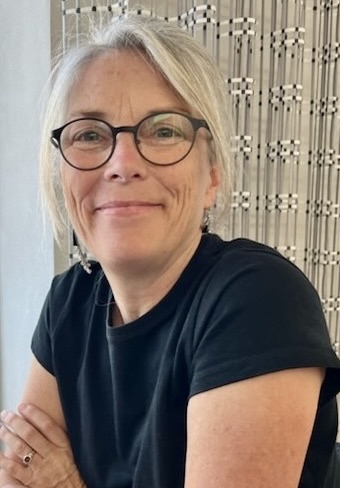

Jane Théau is coming to us from Melbourne, Australia to explore her horse hair weaving, her embroidery and her imagination for a month long residency at from out of the blue studio gallery.
Jane’s statement about her artist life/ maker’s journey is fascinating and attached below:
I came to art late after careers in science research, project finance and management consulting. I always had art in my life but didn’t start practising until I began printmaking as a counterbalance to the demands of work and raising four children. Our young family lived in France for a year which gave me a lot of time to reflect on regular life, the outcome of which was a decision to ditch the corporate career in favour of a creative one. As a printmaker I had been printing on fabric and transforming prints into three dimensional objects and wanted to explore these paths more rigorously, so enrolled in a Master of Art at UNSW Art & Design with a major in Sculpture, Performance and Installation. There was no looking back! It became clear I was most confident working in three dimensions and loved straying into the fourth through collaboration with performers.
When I discovered soluble fabric I launched into machine lace making, bringing with me from printmaking the aesthetic of the finely etched intaglio line and the incorporation into the lace works of brightly coloured discarded tarlatan (a muslin used to wipe the ink off printing plates). Although 2D objects, they are suspended as sculptures in space and lit to create shadow drawings that are a vital component of the work.
Textiles are tactile and call to our skin and I encourage people to touch my work. The tactile aspect of my practice was formalised in doctoral research: Inciting the Site of the Soul: skin, touch and textiles in contemporary art. The investigation built on the suggestion by the philosopher Michel Serres that our soul is in our skin. One can live without sight, or hearing, or taste or smell, but without touch we simply are not. For this research I worked with horsehair, a product of the organ of touch. It is a fibre with beautiful and unique tactile and visual attributes. This research led to an ongoing series of woven horsehair and wire sculptures that beckon the hand.
My previous careers have been steady influences on the subject matter of my work. A pesky chronic disease, climate change and environmental activism are also vital themes. I long struggled with the decision to abandon a ‘productive’ career and become an artist in a society that is at best indifferent and frequently antagonistic to art and artists. Nevertheless, I keep making, strongly believing that art can encourage people to think differently and perceive their world and the issues it presents through a different lens. In a fracturing society this is surely an important thing.
We are super excited about having Jane in residence and look forward to getting to know her and her practice. In the meantime Jane has answered our written interview:
What initially attracted you to the methods you use for your art practice?
Although I began as a printmaker, sculpture and textiles have become my territory. Printmaking has influenced the development of my lace practice, through both the aesthetic of the finely etched intaglio line and the incorporation into the works of brightly coloured discarded tarlatan (a muslin used to wipe the ink off printing plates). Although 2D objects, they are suspended as sculptures in space and lit to create shadow drawings that are a vital component of the work.
Tarlatan has also found its way into layered embroidered paintings that are framed in three dimensions. The randomness of the ink stains guides the embroidery, and the loose weave of the tarlatan creates opportunities for playing with shadow and passing thread through. Again, the shadow as well as the space, is an integral part of the work.
In the last few years I have been creating sculptures made of woven horsehair. I discovered this amazing fibre when one escaped from my cello bow. It is a unique fibre that is not floppy like thread or stiff like wire but somewhere in between, and it has an intriguing translucency. I took some to a residency at Textilsetur in Iceland, and in this beautiful old building was an attic full of looms. I had never woven before but of course I began weaving horsehair there! Some of these highly textured, animalistic textiles are paired with bronze elements. The lightness of the horsehair is a wonderful tactile contrast to the ponderous weightiness, coldness, and rigidity of bronze. I find that spending so much time working with textiles sometimes generates a tactile need to bash some metal around.


What or who were your early influences and how has your life/upbringing influenced your work?
My grandmother! Undoubtedly my grandmother. In the domestic mess that is generated by divorce, Gran became the touchstone in my life, and her home became my safe place.
She was an indomitable woman: intelligent, hardworking, a sharp card player, a prolific craftsperson, an accountant and a feminist before her time. She believed all women should be masters of their own destiny (and accordingly taught over twenty women to drive). She planted the seed of this conviction early. Another gift Gran gave me was a love of textiles. She taught me to sew and knit and crochet and left me to explore her garage which was full of used dress patterns and balls of wool and bolts of cloth that incited my creativity. She would take us to vast fabric warehouses in Silverwater where a pervasive pall of industrial pollution assaulted my nose, and there I would get lost between rows upon rows of tables laden with upholstery and dress fabrics, wedding lace and stretch materials, nasty nylon netting for curtains and plush rolls of sensuous velvet.
Gran always had three or four projects on the go. At one point she established a not-for-profit craft shop in Eastwood (Sydney) called The Purple Patch. It had the dual aim of raising money for charity and provide a means by which women could earn money to achieve some financial independence. Gran wasn’t an artist but she had a truly creative soul.
What was your route to becoming an artist.
The route was … internationally erratic. My first career was in science research in New York in neurobiology and electron microscopy. I then worked in project finance and management consulting in Europe and met and married a Frenchman. When we returned to Australia, I worked for a not-for-profit microfinance organisation based in Sydney. When our four children were young, we took a year off to live in a small village in the Pyrenees so they could learn their other culture and I decided during that year that I couldn’t return to corporate life. I spent many years studying printmaking in my spare time to satisfy a creative itch and decided to commit to a creative life and enrolled in a Master of Art on our return. I went on to do a PhD on the subject of textiles and tactility in contemporary art at ANU.
Tell us a bit about your process from conception to creation please.
I’m not an artist who draws and sketches ideas. I just start. It’s in the touching and doing that my thoughts and visions become things. I envy people who can draw well and plan. I trust in serendipity. As is obvious from the above, this is not just the story of my art practice but of my life too! My art is detailed, sculptural and slow to create. It is made only from natural or repurposed materials and focusses on tactility, the environment and portraiture.
Art encourages people to perceive their world and the issues it presents through a different lens. I believe it has the power to provoke thought and wonder and delight. This is what I aim for in my practice, to create a space where people might wonder how and why the work was made and engage with the ideas behind it.
You have a wide range of patterns and arrangements and objects in your portfolio of works can you describe some of your chosen techniques and how you choose to use them?
My lace practise began purely because I discovered dissolvable fabric. It was a revelation! and opened up so many possibilities of disappearance, absence and presence. The world is so full of stuff that I love lace because it is full of holes and barely there. I don’t feel guilty bringing it into a world overflowing with things. With lace I focus on portraiture, and I can’t say why. I make them life-sized so they have a real physical presence when suspended in space, like characters on a stage. This thought led me to collaborate with choreographers and dancers, creating portraits of dancers that they perform with live or for videos. The most important collaboration was with NZ choreographer/filmmaker Sue Healey on her production of dance portraiture On View: Panoramic Suite which toured Japan, Hong Kong and Sydney in 2020/21.
What currently inspires you?

Bob Brown, founder of the Greens and environmental hero. Tasmania’s wild places. Trees. People who hate shopping as much as I do. The Post Growth Institute. Musicians. Anyone who smiles.
Is there a piece of your work that holds particularly fond memories for you and why?
#MeToo, the portrait I made of Julia Gillard. During the three years of her tenure from June 2010 to June 2013, she was subjected to blatant misogyny and bullying, largely orchestrated by the Leader of the Opposition, Tony Abbott, who attacked her for gender specific subjects such as her decision to have no children, for her body shape and for the clothes she wore more frequently than for her policy decisions and actions as the leader of the nation. The placard that was strategically positioned next to Tony Abbott during a rally saying “Ditch the Witch” encapsulates a Middle Ages brand of misogyny and attitude to women that bubbles under the surface of certain sections of contemporary Australian society. When, in October 2012, Abbott accused Gillard of sexism she had had enough and responded with her now famous Misogyny Speech.

For me, as for millions of other women who applauded her speech, it was not the political issue at its centre that resonated, it was the fact that finally, loudly, the undercurrent of misogyny that is the lived experience of women was called out. In that speech, Julia spoke for each of us. My way of acknowledging the importance of her words, as well as her achievements as Australia’s first female leader, was to create her portrait in the feminine medium of lace.
#MeToo is based on the biblical story of Judith and her victory over Holofernes, a man who underestimated her. It was a common parable used during the Renaissance and Baroque periods to demonstrate the power of women. It was inspired by two works of art from the seventeenth century: The exquisite lace panel Judith and Holofernes in the Lace Study Centre of the Powerhouse Museum which made me realise that the medium of lace had narrative power; and Judith with the Head of Holofernes by Cristofano Allori (1613) which influenced the composition and colouring. In #MeToo Gillard wields her Misogyny Speech instead of a sword and the head she holds is male misogyny.
I made #MeToo with my daughters Mahalia and Anyes and their generation in mind. It’s a reminder that whenever misogyny’s ugly head slides out of the dark, we must respond robustly, as Gillard did. The portrait won the Australian Design Centre Award in 2018 at the Seed Stitch Contemporary Textile exhibition.
How has your work developed since you began and how do you see it evolving in the future?
My practise has evolved erratically, changing when a new material or technique or issue inspires me. I would like to revisit the bronze/horsehair pairing and I have also started a new body of work of threaded, layered, painted gauze.

What advice would you give young people considering following their dream of being a full time artist?
That’s a tricky question, given that it’s a career that is unlikely to produce a living wage – there is obviously a financial aspect to consider. I can’t speak for your experience in New Zealand, but in Australia support for artists has declined steadily for the past few decades to the point where the situation is particularly dire – as an example an organisation as important to artists and craftspeople as the Australian Design Centre has lost its funding and will close this year. Art and culture are public goods and without government and philanthropic support, they die.
On the positive side, even though I struggled with my decision to leave a ‘productive’ career that garnered respect in a capitalist society, I have never regretted the decision to devote myself full time to creating art. It is by far the most fulfilling job I have had. It daily feeds my soul.
What is something you cannot take your eyes off when you see it – that fascinates and
mesmerises you?
Water. It not only arrests my eyes, when I see a lot of it I must jump in and feel it.
Trees. Without them around me I wither. Their beauty, greenness, stoicism, variety, generosity and importance inspire me every day.
What is your favourite way to unwind or de-stress?
Chess and drums.

Please check out Jane’s instagram account: http://nstagram.com/janetheau/
CV for Jane Theau
Residencies
from out of the blue studio gallery, Opunake, New Zealand (June 2026)
Bundanon Trust Artist in Residence, Illaroo, NSW (2017 and 2019)
Textilsetur, Blonduos Iceland (2017)
BRAG Hill End Artist Residency, Hill End, NSW (August 2015)
Prizes
Australian Institute of Architects Award for Sustainable Architecture – with A Symes and Second Edition (2023)
Australian Postgraduate Research Scholarship (2017-2020)
Grace Cossington Smith Early Career Award (2018)
Australian Design Centre Award (2018)
Nonesuch Art on Paper Award (special mention), Montreal (2016)
Artist at the Armory Award (2014)
Ewart Prize (2014)
Rookwood Necropolis Sculpture Award (2012)
Cessnock Regional Gallery Exhibition Award (2011)
Selected Curatorial Projects
Laced, Australian Design Centre (2024)
Feast, Primrose Park Art and Craft Centre (2022)
Art That Moves, Willoughby Art Centre
Imag(in)ing, Ewart Gallery (2018)
Art Without Agency, Ewart Gallery (2017)
www.w, Ewart Gallery (2016)
Y Fibre, Ewart Gallery (2016)
Solo Exhibitions
Wild and Wilder, NSW Embroiderers Guild, Concord West
The Crowd, Sydney Creative Studios, Sydney
Dancing Through Disaster, Barometer Gallery, Paddington
Touch me, remind me I am here, Barometer Gallery, Paddington
Sunbaking in Oslo, Incinerator Art Space, Willoughby
Planned Obsolescence, Accelerator Gallery, Sydney
Selected Group Exhibitions
Meraki, Tamworth Regional Gallery, 2026
Make Award, Australian Design Centre, Sydney, 2025-26
Ravenswood Women’s Art Prize, Ravenswood School, Sydney, 2025
Weaving Matters, Australian Design Centre, Sydney, 2023, 2024-25
Woollahra Small Sculpture Prize, Woollahra Gallery, Sydney, 2021, 2024
On View: Icons, Sydney Dance Company, Sydney, 2024
Arboreal Narratives 2023, Woollahra Gallery, Sydney, 2023
Blake Prize, Casula Powerhouse, Liverpool, 2022
On View: Panorama (dance production), Yokohama, Hong Kong, Sydney, 2020-22
Tamworth Textile Triennial 2020, toured nationally, 2020-22
Sculpture in the Vineyards, Wollombi, 2022
North Sydney Art Prize, Coal Loader, Waverton, 2015, 2019, 2022
International Embroidery Art Biennale, Chaozhou, China, 2018
Grace Cossington Smith Art Award, Wahroonga, Sydney, 2018
Seedstitch Textile Award, Australian Design Centre, Sydney, 2018
Stitched Up, Lockup Gallery, Newcastle, 2017
Just Draw, Bathurst and Newcastle Regional Galleries, 2016
Nonesuch Art on Paper Award, 2016
Slipstitch, toured Victoria and NSW, 2015-16
Wangaratta Contemp. Textile Award, Wangarratta Gallery, 2015
Lester Portrait Prize, Linton and Kay Gallery, Perth, 2015
Love Lace, International Lace Award, 2011-13
Hidden Sculpture Prize (winner 2012), Rookwood Cemetery, 2012, 2014, 2023
Community Art Projects
| Meeras Pavilion, Rohingya awareness project, Circular Quay, Sydney, 2025 Fabric for a Feast, Primrose Park Art and Craft Centre, Cremorne, 2015 – ongoing Textiles Repair Cafes, various venues, 2022 – ongoing Finding Your Feet Rug Project, Auburn Community Centre, NSW, 2018-20 |
| Occupy the Fence, Manyana NSW, 2020 |
| The Tapestry Couch, refugee art project, Auburn Community Centre, NSW, 2015-17 Education PhD, Australian National University, Canberra Master of Art, UNSW Art & Design, Sydney Master of International Affairs, Columbia University, New York Bachelor of Applied Science (Biomedical Science), University of Technology, Sydney |
Authored work
Fabric For a Feast, Garland Magazine, Issue 36
Touching Art, Garland Magazine, Issue 33
Finding Your Feet: A Community Tapestry in Full Bloom, Garland Magazine
Tapestry Transformed: Annika Ekdahl, Craft Arts International, Issue 95
Jutta Feddersen: An Extraordinary Life, Textile Fibre Forum, Issue 114
Pyreneen Odyssey, self-published
Microplastics: Making the Invisible Visible Inke Falkner PhD., Jane Theau, Alana Rooney, Jackie Slaviero, J. Marine Education, vol 32, no 1
Extended Resume
World Crafts Council Australia, President, 2025-ongoing
Textiles Sydney, Founder and President, 2019-25
Established Textiles Sydney to promote art made with textiles. Its membership has grown year on year and its scope has widened to include workshops, community art projects, open days, film screenings and repair cafes.
Refugee Art Projects, Facilitator, Auburn Community Centre, 2016-20
Facilitated the Tapestry Couch and Finding Your Feet projects with Sayd Abdali and Tasman Munro in collaboration with Settlement Services International.
Workshop Art Centre, Willoughby, 2014-18
Initiated a cultural programme to augment the teaching base, steered the redevelopment of the premises and was Director of the Festival of Other Arts (2015-2018)
Living a Life Less Plastic, 2013-17
Developer and presenter of an environmental education programme for primary school children in collaboration with the Sydney Institute of Marine Science.
Opportunity International, Sydney, 2001-05
Managed a federal government funded pilot project providing microfinance to the Bundjalung community in NSW (the first of its kind in Australia), monitored OI’s projects in the Philippines.
Ernst & Young Management Consultants, London, 1992-93
Member of team advising the Hungarian government on its national provatisation strategy, the Czech and Slovak Republics on the establishment of their stock markets, and the British government on the financing options for the privatisation of the Docklands Light Rail.
UBS, Zurich and London, 1990-93
Westpac, New York and Sydney, 1988-89
Columbia University Biology Department, New York, 1987-88
Researched the differentiation of motor neurones using electron microscopy and biochemical techniques.