
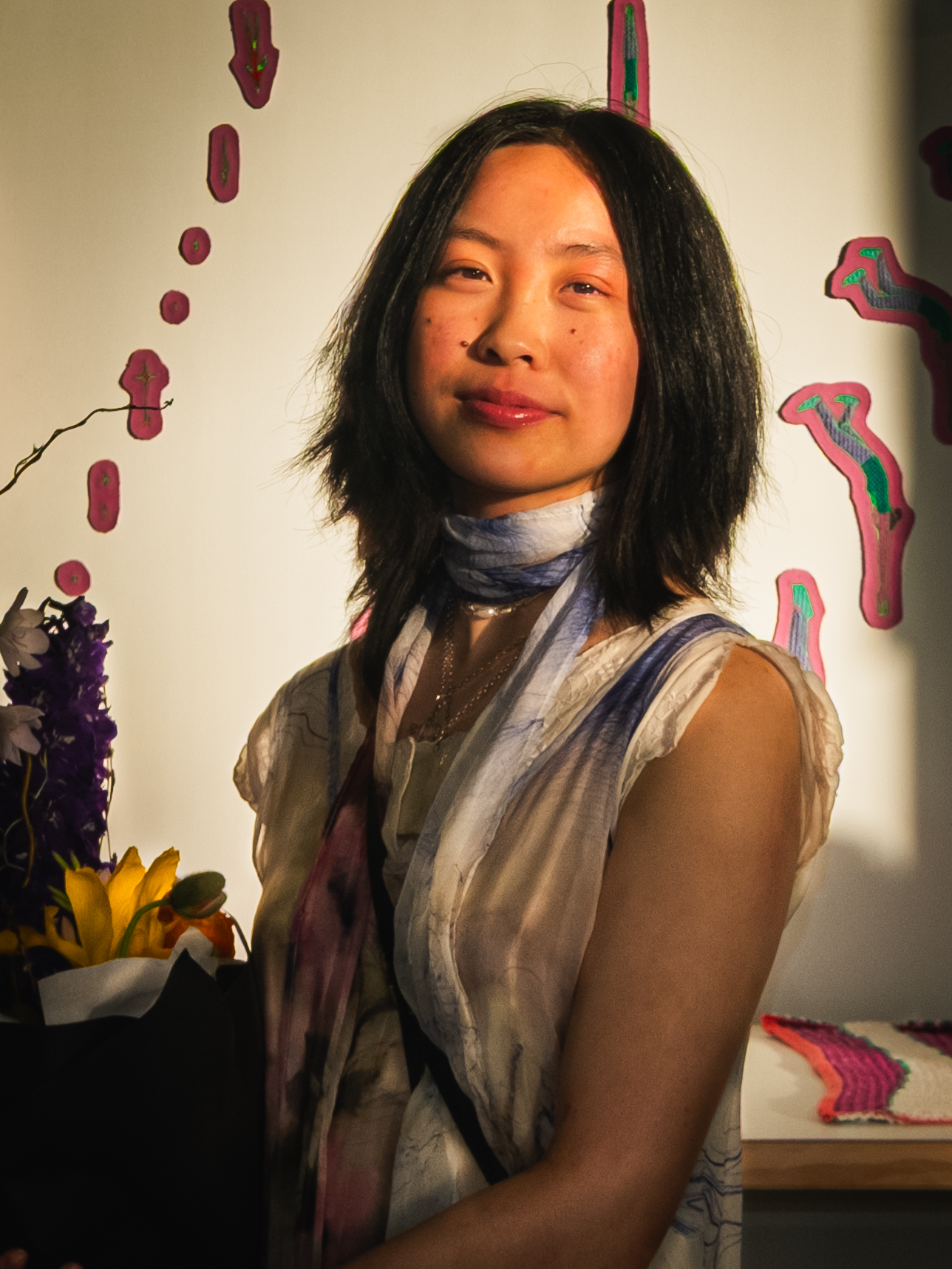
Artist in Residence 14th Jan- 21st Jan 2026
Fiona is one of the younger artists we have been honoured to have as a Resident Artist at the studio gallery. Having recently finished a Creative Arts Bachelor’s Degree with First Class Honours from Massey University College of Creative Arts. Fiona’s work includes woven textiles used in animated sequences and 2D fabrics. As part of her studies Fiona earned the award for The Most Technically Advanced Project in her cohort. She has also been nominated for the 2025 Society of Dyers and Colourists Competition called ‘ Colour for Adversity”
Here is her Artist Statement:
Hello, I’m Fiona Peng, and my Kaupapa is to ask myself how I can grow and evolve my textiel practice with every opportunity. My roots are in illustration, and everything ebbs and flows fro there. Because of this, I resonate deeply with the belief that colour and materials can tell many stories, of many people and of many histories and futures – this is my basis for creating cloth. I have the desire to become a storyteller, embedding many narratives into the work I create.
Born and raised in Taranaki, I consider myself lucky to have grown up surrounded by reserves, the beach, and, most importantly, the mountain. By 18, I moved to Wellington to pursue a degree, and after five years, I am grateful to have found my calling in textiles.
In Residence, I am excited to sit in front of the Glimakra Loom and to bask in its glory. Starting by observing the threading and the small handles, I want to explore how various weaving techniques intertwine themselves into the cloth.
Fiona first came into the studio gallery on a chance encounter with her family on a day trip to Ōpunakē and then quickly discovered the Drawloom upstairs in the studio space above the Gallery – that was love at first sight.
It is very exciting for us to have someone who has worked on a jacquard loom so understands the design possibilities of a damask loom.
I am attaching the link for Fiona’s Website – please take a look at the various types of works she has been creating.
Here is a smaller teaser of her portfolio.


As has become our practice we have asked Fiona to respond to our written interview questions so we can get to know her a little before she joins our community as Artist in Residence. Here is her interview:
What initially attracted you to the methods you use for your art practice?
My spark in textiles began with an interest in materialisation. I was always a drawer, but as I was growing up, I had an inkling that I could do more with illustration than just putting a pen down on paper. It wasn’t until I was introduced to the design major at Massey University that I discovered this new world of creative expression for my sketches.
What or who were your early influences, and how has your life/upbringing influenced your work?
I was raised with a TV at hand, which became such a large source of influence for me. I grew up watching shows such as SpongeBob, Barbie and Disney movies, which is the basis for my artistic style and storytelling.
My parents came from a long line of labourers. My mum’s lineage has a deep history with New Zealand, starting from the Otago gold rush, which led my mum to this country. My dad also uprooted his life to move here in his late 20s. Throughout my upbringing, they worked hard for their children, and this is the case for dozens of generations before theirs. It’s interesting to me to know that the odds of my lineage knowing how to weave, dye and/or sew are very likely, and that this labour all amounted to a life in Aotearoa.
So, when I turn around to see my textile practice, it feels like I’m acknowledging my family, acknowledging their blood, sweat and tears, and the freedom they have granted me to choose my future. And for that, I am thankful.
What was your route to becoming an artist?
My pathway to artistry began with the cartoons that inspired me, shaping my high school studies to be focused on art and design. This directed me down a creative path to where I am today. Also, my interest in curating and arranging came from collecting LEGO at a young age!
Tell us a bit about your process from conception to creation, please
I was taught the classic ‘double diamond’ method of design. It’s an iterative process where it begins with an interest or idea that is developed multiple times, all through mood boarding, yarn wraps, small sampling and image ideation. This is then narrowed down and finalised as a finished textile collection.
You have a wide range of patterns and arrangements, and objects in your portfolio of works. Can you describe some of your chosen techniques and how you choose to use them?
My favourite chosen textile technique used in my body of work is motif design. In both my weaving projects, I’ve used motifs for different purposes and to achieve different ideas. One was to replicate the look of a sticker sheet. The other was to create a textural effect to emulate emotions.
The other technique I adore is machine knitting. I was formally taught on the domestic single-bed Brother knit machines, but moved on to the digital double-bed counterpart, which in turn gave me the ability to knit up to four strands of yarn. This skill has been utilised for various reasons in my projects, such as communicating how to knit a sweater, animating a scene in my honours year, and exploring hand manipulation techniques with double bed knitting.
What currently inspires you?
Recently, the Festival of Lights in Pukekura Park have been inspiring me. Every year, they curate different works that fill the space. Each artist has their own interpretation and rendition of the same sites. I have a lot of respect for these fellow creators for the way they work with light, space and sound within the public display context, as well as the storytelling behind their works. Particularly, the installation, “Cosmic Swarm” by Catherine Ellis and Angus Muir, captured my attention. The exhibition is engaging and beautiful, engulfing my vision in twinkling light. I’m impressed by its animation and use of scale.
What advice would you give young people considering following their dream of being a full-time artist?
If you don’t know where to start, begin by finding a good professional camera or find someone with one and a good eye to photograph your work, as well as the process. This is especially true for those in the textile industry. Lastly, don’t ever give up on putting yourself out there!
What is something you cannot take your eyes off when you see it- that fascinates and mesmerises you?
During one of my research projects, I discovered the book ‘The Roots of Chinese Weaving’ written by Eric Boudot and Chris Buckley. The book documents the invention of the draw-loom as well as weaving techniques that reflect the culture, mythology, and location of many ancient villages. The book stood out to me due to the detailed photography of the weave, including the reverse side. The sheer amount of information in the book has left a lasting impression on me.
Is there a piece of your work that holds particularly fond memories and why
My Crochet Flora Blanket series. This is a collection of three granny square blankets I created during a period of stillness and contemplation before I decided to pursue my degree. These pieces are significant to me as they were the starting point for my passion for textiles. It gave me the space to explore my creative design process as I completed it during my gap year. This period gave me the limitless freedom to start my textile design journey.
How has your work developed since you began and how do you see it developing in the future
Over the years, I have picked up so many valuable techniques that have served me and my interests, which are now showcased in my portfolio. In my studies, I selected papers that went beyond my major, which include fashion and animation classes. These gave me valuable skills that I utilised in my work, particularly in my final project, “Where I go, Fabric goes”. This is a short film animation that I took on because I merged two unconventional subjects together.
Now, I want to open a new door for textile materialisation by pattern making for the 3D form. This residency will be a stepping stone in my journey as an artist and designer, giving me new opportunities as I progress into my career.
What is your favourite way to unwind and destress
I cherish the moments I have in my hometown with my family. We spend most of our quality time together walking our neighbourhood during the evenings, searching for cats in the area to greet. My favourite way to destress is listening to music, especially during the small in-between moments like walking back home, having a shower, and being on the bus.
Thank you Fiona for such in depth sharing – these responses have opened my eyes to new things, I’m looking forward to learning with you while you are in residence.
We do hope you will come and enjoy having Fiona working on the drawloom in the studio. It will be a wonderful opportunity to see the equipment in action and to meet a rising star of NZ’s textile world.