
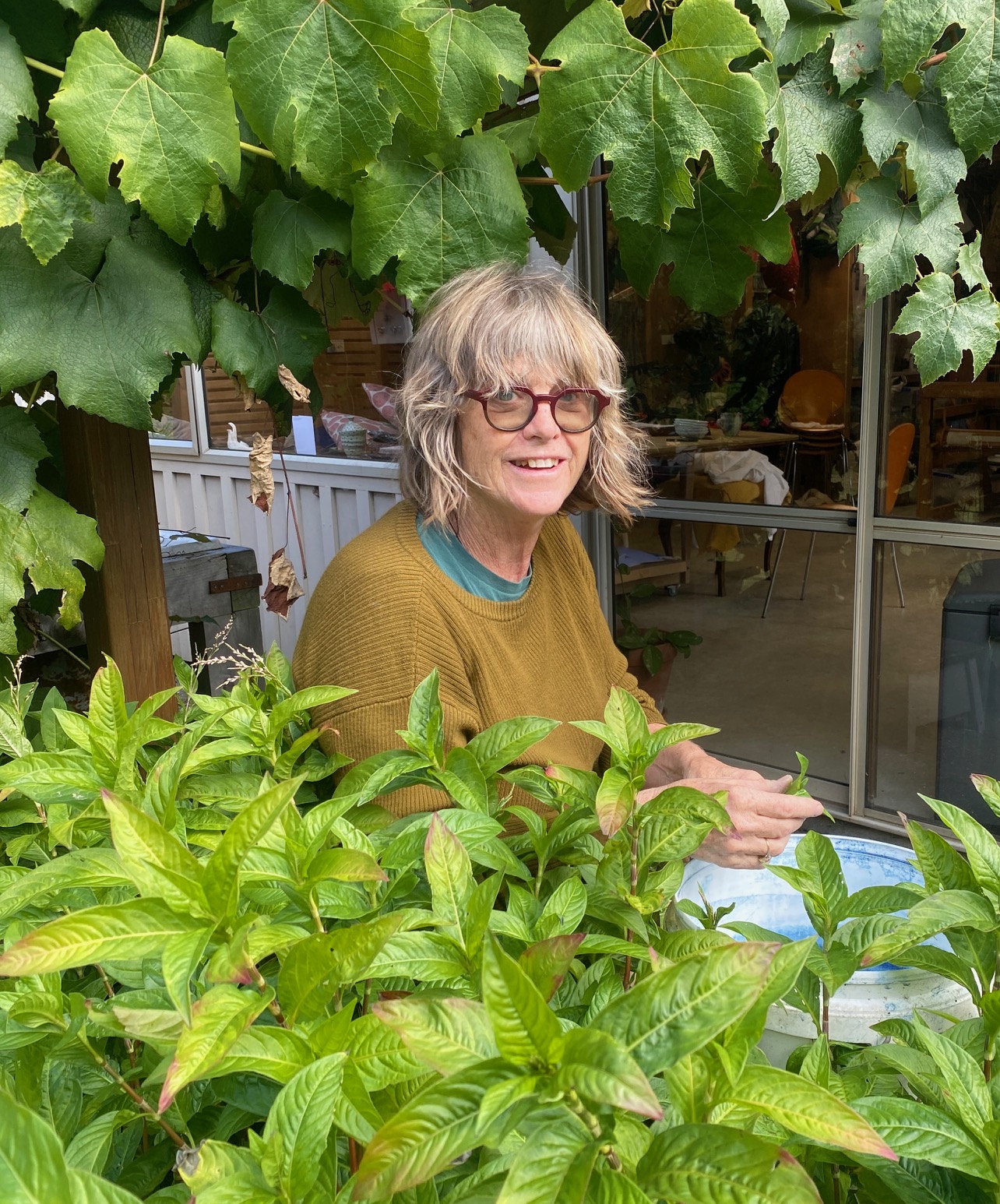
Lizzy is filing our gallery with materials dyed from natural sourcesthe 19th June 2025 for a 6 week period. Lizzy is exhibiting with us for the first time but she is well known in the New Zealand art world. I recently sent her our ‘getting to know you a little bit’ questionnaire and here are her answers.
What or who were your early influences and how has your life/upbringing influenced your work?
My grandmother Googie was a dedicated and talented artist with her exceptional crochet spinning, knitting, natural dyeing, leatherwork skills. She taught me to spin, sew and knit as a young child. She would take me into the bush to collect dye plants. Actually I first learnt to weave as my grandfather was shown how to weave as therapy for his hand which was injured on the Somme in WW1. He was instructed how to make a simple loom and thats what he carried on doing. Leaving weaving to Googie and me. My whole family are creative in one way or another. Builders, Designers, Gardeners and Cooks.
What was your route to becoming an artist.
After I finished high school I studied an intensive year long weaving course in Nelson. I also attended one year of the Craft Design Course at Otago Polytechnic.
I exhibited work in my early 20’s.
I have always been around art. I have also worked as an assistant for my husband who is a sculptor. This has given me a chance to be part of national and international exhibitions.
Tell us a bit about your process from conception to creation please.
Some things are born from process -one thing leads onto another. Other times I might be going for a walk and the idea just comes into my head. Then I have to work out how to bring it into reality.
What currently inspires you?
Nature. Always has , Always will. Dyeing with plant materials. Its always exciting to see what colour comes out. There are so many variables.
How has your work developed since you began and how do you see it evolving in the future?
For many years I have been weaving with harakeke, some sculptures,mostly functional ngā pōtae (hats) and kete.
Its been great to dive back into my loom weaving as well. I was kickstarted again when I started dyeing wool from plants in my garden.
I am excited for future projects and learning. I would like to research my Scottish heritage more as Scotland has a rich history of dyeing and weaving. All their tarten colours came from natural dyes.I would like to learn more about the symbolic meaning behind the colours and patterns.
I also like to work collaboratively with other artists so I see myself doing this in the future. And to have more exhibitions.
What advice would you give an aspiring artist?
Work on something everyday. It could be 5 mins or the whole day. Keep your practise alive.
( I need to follow my own advice!)
What is your favourite way to unwind or de-stress?
Walking, photographing and hanging with friends. I find weaving very relaxing and meditative too.
Now I am going to tell you a bit about my work in this show “Mapping Colour”
I have named the main installation work-
“Colour is feeling
Colour is memory
Colour is sound
Walk with me”
This is a colour map of all my dyeing experiments over the last 5 years. Dyed materials are interwoven with textures of plant materials and weavings. I am inspired by lichen dripping on the trees and seaweeds strewn across the beach. The cycle of life and death as one. A healthy forest is breaking down as much as growing, all things interconnected.


I have also been using clay
The work “ From Kōpū to Otama” is made from the many coloured clays from around Tara-o-te-ika-a -Māui (Coromandel Peninsula) This is also a map and a journey. It is more of a drive than a walk as the clays are collected from roadside slips.
I have also used some of the clays to paint the Hue (gourds) that I have grown in my garden. I have been making these works for a number of years now.
The weavings I have made with linen warp. To gently hold the precious taonga plants Harakeke, Houhere, Toitoi.
I have woven Houhere (Lacebark) and linen to make a lace curtain.
Another of these works is is an record of how some of the different cultivar harakeke plants dry. I planted these Harakeke in a “flax library” a number of years ago. The plants were sourced from Auckland Botanic Gardens.
When I am dyeing my wool I aften add other materials to the dye bath. I have used alot of plant dyed muka in these works as well.
While I am on residency I want to work on a weaving that is inspired by Morning Star shells.